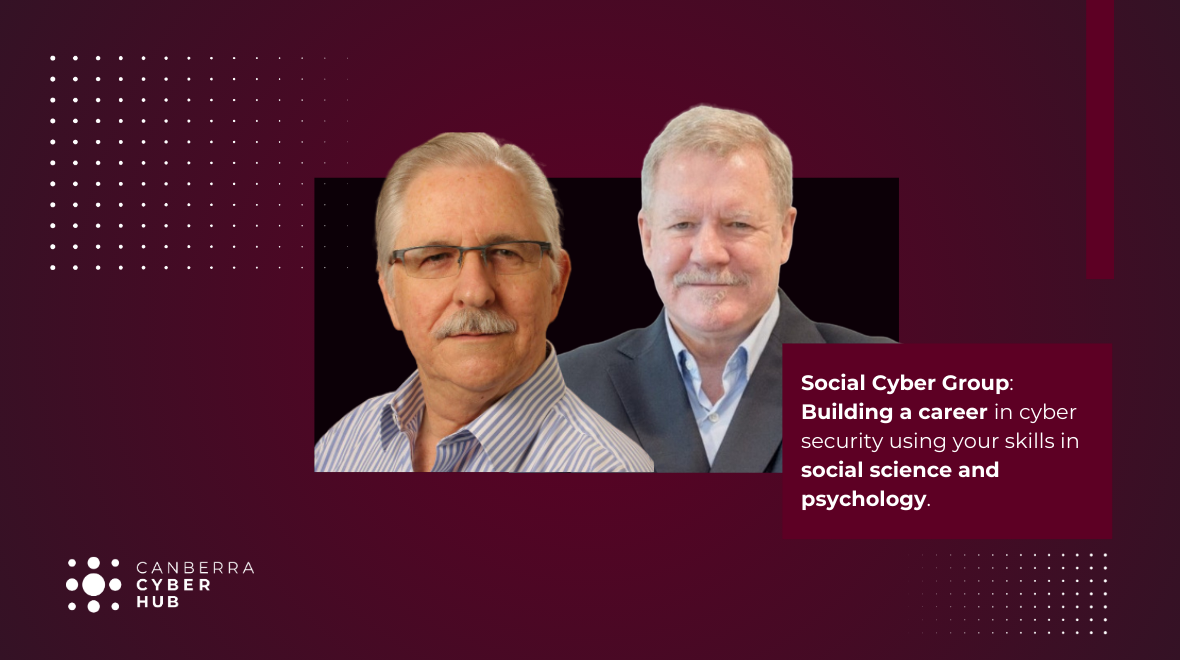
If you’re studying psychology, sociology, or international relations, you might think the world of cyber security is closed to you unless you can code in C++ or have a myriad of deep technical skills. But according to our talk with the Social Cyber Group, this couldn’t be further from the truth. In fact, they argue that the next generation of cyber leaders won't just be engineers; cyber security requires passionate social scientists and psychologists, in growing numbers.
We spoke with the group about how students and career-changers can bridge the gap between "human" insights and digital defences.
The "Sovereignty Delusion" and Your Opportunity
A major theme for the Social Cyber Group is that Australia (and even India, the USA and China) often suffers from a "delusion" that technical sovereignty is just around the corner. The reality is that we are part of a massive, interconnected global ecosystem, which creates a huge demand for people who understand policy, diplomacy, and human behaviour.
"There is a bias in Australian approaches to cyber security... that if you don't have technical qualifications... you can't possibly be of value. But the reality is, we need to bring in behavioural science, psychology, ethics, and political science for regulations and guardrails." - Glenn Withers.
Why Psychology is a Cyber Superpower
One of the most critical threats to any organisation are humans - you’ve likely heard the saying that “humans are the weakest link”. Whether it's the "insider threat" or a senior executive mismanaging a crisis, the social science behind security is where the biggest challenges condense.
"The psychological impacts of individuals on cyber security are already somewhat well understood... Yet companies don't look closely at what sort of structural mechanisms they should put in place to manage things like insider threat or team psychology." – Greg Austin.
If you understand how people think, how they react under pressure, and how social structures influence decision-making (a technique the group calls "Power Mapping"), you have a skillset that many technical teams lack.
Canberra: The Ultimate "Social Cyber" Sandbox
For students at ANU, UC, or CIT, Canberra is a really unique place with a strong ecosystem, where "everyone talks to each other."; it’s extremely well-interconnected. The Social Cyber Group highlights that Canberra’s "interpersonal leverage" makes it the perfect place to start such a multi-disciplinary career.
"Canberra is a fantastic ecosystem... We are all able to talk to each other quite well. For us, our experts were spread across university systems and consulting, so we decided to build the Social Cyber Institute within the group to bring these individuals together, into a community of practice,” said Glenn Withers.
How to Get Your Foot in the Door
So, how do you actually make the move? The group is a big believer in micro-credentials and internships that blend your existing knowledge with cyber-specific policy.
- Internships: The group and many other organisations regularly host interns to bring a fresh perspective into the mix, and support individuals in applying their skills to new scenarios.
- Executive Education: The Social Cyber Group, CIT and some universities offer pathways for "mature age" learners and career-changers through short courses and graduate certificates alike. These courses can help you learn how to use new tech, and apply your already established soft skills to new scenarios.
- Networking: Given Canberra is so well-interconnected, you’re never more than 3 introductions away from any area of cyber. Talk to people, meet new peers, and attend events to build your circle up and see what opportunities are in the sector.
"Our philosophy is to be creative without losing the foundations and just modernise it... making it interesting to the learning students." – Greg Austin.
So, what's the final advice for the next generations?
Don't be intimidated by the "tech-only" crowd. The industry needs critical thinkers who can look past the screen and see the society and psychology behind it.