Although the word quantum may make you think of scientists working in a lab, abstract mathematics, as well as Schrodinger with his alive and dead cat, the field of quantum technology is much vaster. The lasers you use to play with your (alive, since you’re observing it) cat, MRIs and the billions of transistors making your phone’s CPU work, are all examples of quantum technologies.
These may have been born in a lab from abstract mathematics but nowadays, they underpin much of our existence. Quantum Brilliance is one of those companies making quantum technologies an everyday reality.
Quantum Brilliance is a Canberra-incepted company which is now a global leader in diamond-based quantum technology, specialising in the design, fabrication, and manufacturing of small, ruggedised diamond quantum devices operating at room temperature. A few months ago, they integrated a room-temperature quantum computing cluster, “Quoll”, at the Oak Ridge National Laboratory in the U.S. Quoll is a cluster of three parallelised quantum computers, each consisting of a quantum processing unit, a GPU, and a CPU. This platform allows for the development of hybrid classical-quantum architectures. In October, Quoll made the TIME’s Best Inventions of 2025 list.
We sat down with Jayden Castillo (Chief of Staff & Director of Strategy), and Biliana Rajevic (Director of External Communications & Media Relations), to talk about the development of the quantum sector for students and career-changers.
First, Jayden and Biliana explored the challenges associated with finding talent. Here’s their takeaway:
It’s not all about the “perfect” CV
For Jayden, finding great people is all about learning their mindset.
“There’s been a lot of learning about what good talent looks like, and it’s not always the people with the best resumes who end up being the most valuable. It comes down to attitude and motivation.”
“We’ve hired interns from ANU who were incredibly valuable,” Jayden explains. “Some stayed long term. One of them has now been here for three years. You never really know where these people are going to come from.”
As a student, your curiosity, persistence and motivation matter just as much, if not more, than your transcript and resume.
What are the skills underpinning the development of quantum chips?
Because the quantum industry is so new, Quantum Brilliance needs to work across the full quantum tech stack, developing hardware, algorithms, software and control for its quantum computers and sensors. Jayden sees several big areas where new talent will be needed in the coming years for the quantum industry:
“Across the industry, there’s still a lot of space to work on quantum algorithms; it’s one of the more accessible and high-leverage places where talent can be really useful,” he says.
On the hardware side, the work centres around refining the chips:
“There’s also space in quantum error correction, which is going to get even bigger in the next 5-10 years,” he adds. For Quantum Brilliance, the skillsets that are needed, as Jayden posits it, “are the skillsets that exist in traditional semiconductors – things like chip stacking and advanced packaging – but it’s not a very common skillset to find in Australia, unfortunately. We’re going to need a lot more of them in the next five years.”
If you’re into maths, coding, electronics or materials engineering, there’s a clear path into quantum development for you.
But importantly, the quantum industry needs people-people too.
Biliana highlights that quantum development isn’t restricted to scientists and technicians.
“As quantum becomes more commercial, you’re going to need account managers to manage partner relationships, sales people, marketing managers, designers,” she says.
“People can bring their expertise into a quantum company, then be trained up to the level of understanding necessary for their function,” she explains. “There are opportunities for people in operations and all those roles for people who are excited about deep tech and want a fruitful career in a deep-tech organisation.”
Where do you start?
Jayden’s advice for getting started is very hands-on:
“First, get familiar with the tools. There’s a lot of free stuff out there – IBM’s Qiskit and similar software platforms are great if you’re interested in the software side.”
IBM and others now host open, free learning portals where you can run real quantum circuits in the cloud and work through beginner-friendly courses.
He also points to broader ecosystem supports.
“There are also organisations like Quantum Australia, running educational programs and events where you can build your network and learn more about what it means to work in quantum.”
Making yourself known; coffee chats and networking.
There’s no single “right” way into the quantum technology industry, and Biliana is honest about that:
“It’s hard to say, ‘If you do this, then we’ll need you,’ because needs can change, right?”
“But you can be proactive.”
“Reaching out to people and having informal 30-minute interviews, or coffee chats, to understand what a role is really like, the people working there, and the overall culture of the company,” is her advice. “Have a chat with someone, maybe in your penultimate or in your master’s year, so you can narrow down your options.”
There are also explicit Government strategies aimed at nurturing job growth and new opportunities.
Australia’s National Quantum Strategy (2023), for instance, sets a long-term vision for quantum as a A$6 billion opportunity that could create around 19,400 jobs over the next two decades. One of its core pillars is working towards a “skilled and growing quantum workforce."
Here in the ACT, the CBR Switched On economic strategy focuses on knowledge-based growth, climate-smart innovation and attracting high-value, tech-driven industries to Canberra. That vision is backed by substantial skills and education investment through initiatives like Skilled to Succeed and over $100 million in new education and skills funding across recent budgets.
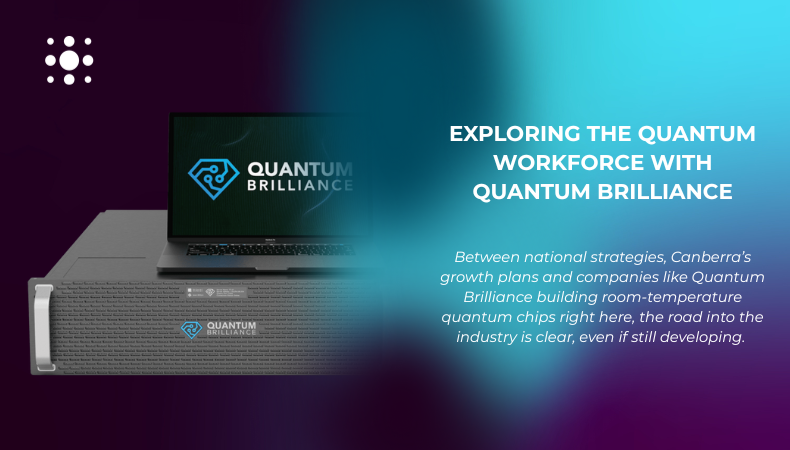
Between national strategies, Canberra’s growth plans and companies like Quantum Brilliance building room-temperature quantum chips right here, the road into the industry is clear, even if still developing.
If you’re curious and motivated, there may very well be a space for you in Canberra’s advanced tech future. It’s all about taking that first step and being proactive.